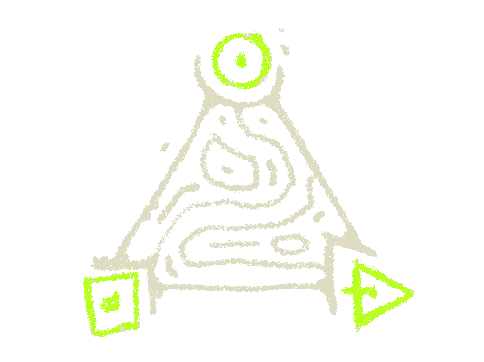
For me, the creative process can be broken down into 3 elements: Concept, Materials, and Execution. Let me make words at you about them and how I use this in my art practice.
CONCEPT
The core idea, theme, thesis, narrative, “soul” of a piece.
This can be as simple as “I think birds are cool” to as complex as some highly esoteric, difficult to describe emotion or philosophical exercise. Whatever it might be, it is the key thing that’s to be captured and communicated in a piece.
MATERIALS
The physical, tangible things that can be used to best convey the Concept: paints, tools, media, found objects, references, research materials, workspaces, the finances needed to afford these things, so on.
EXECUTION
How to use those materials to communicate the concept. Skill and technical know-how, budgeting, research methods, and so on happens here.
With this framework, I can pin point why a piece isn’t working out like I wanted to. If I feel the work isn’t fufiling to make even if it’s done technically well, I know my concept is lacking. If I love the idea but the idea isn’t being understood, I know I need to tweak my execution.
It’s also nice to have some kind of guide to turn to whenever art making gets overwhelming or unproductively chaotic.
FRAMEWORK IN ACTION
EXAMPLE 1 | A STRUCTURED APPROACH
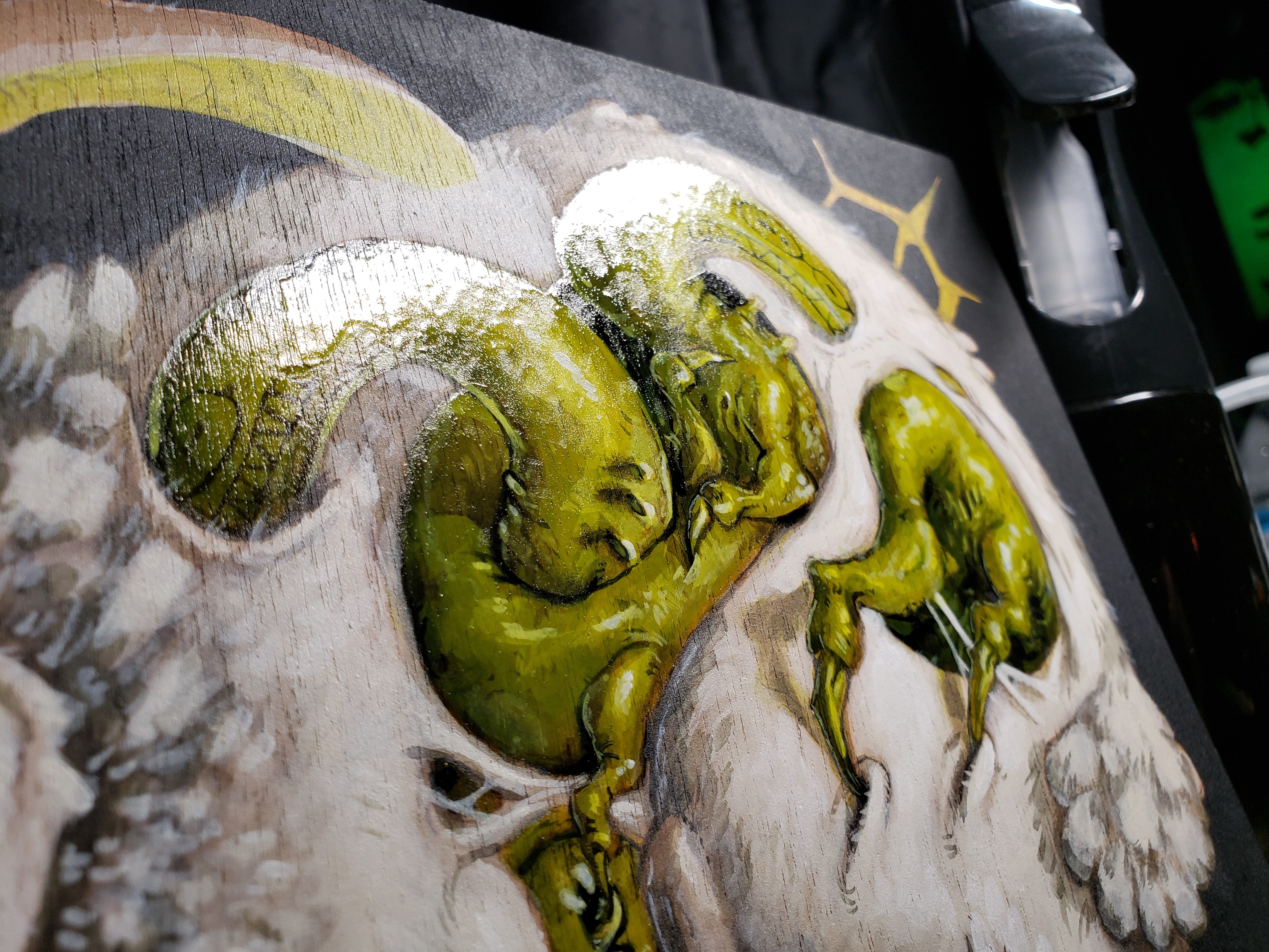
CONCEPT: For this painting, I was compelled to explore this theme: fear and a will to survive as something like an organ that overtakes its host from the inside. I used a rabbit as the subject for this piece. For me, they are an animal that is deeply familiar with the themes I’m trying to wrangle with. I’ll have a more drawn out write-up later when the piece is fully complete, but for this is enough for the sake of this journal entry.
MATERIALS: From there I took stock of my supplies I had on hand, and for any I might need to budget for. I wanted to opt for something tangible for this project. An art object that physically exists in the same space as the viewer hits a little harder than a digital piece caught up in the Internet deluge. And if this piece were ever to exist in the context of a gallery, wood board is more affordable than a high quality monitor. Sure, I could do prints but its just not the same.
I gathered up photo references of rabbits, my notebook to jot down thoughts during the process, bought some new brushes to replace the old frayed ones I had.
EXECUTION: Did a few rough drafts in my sketchbook to get the pose right, redrew the piece on the wood board, talked a little about what I was making and in turn got extra insights that felt relevant to this piece, photographed the piece as I worked on it, decided to play with the surface textures of the piece to add more contrast, all eventually leading to the near-final result.
EXAMPLE 2 | WORKING WITH LIMITATIONS
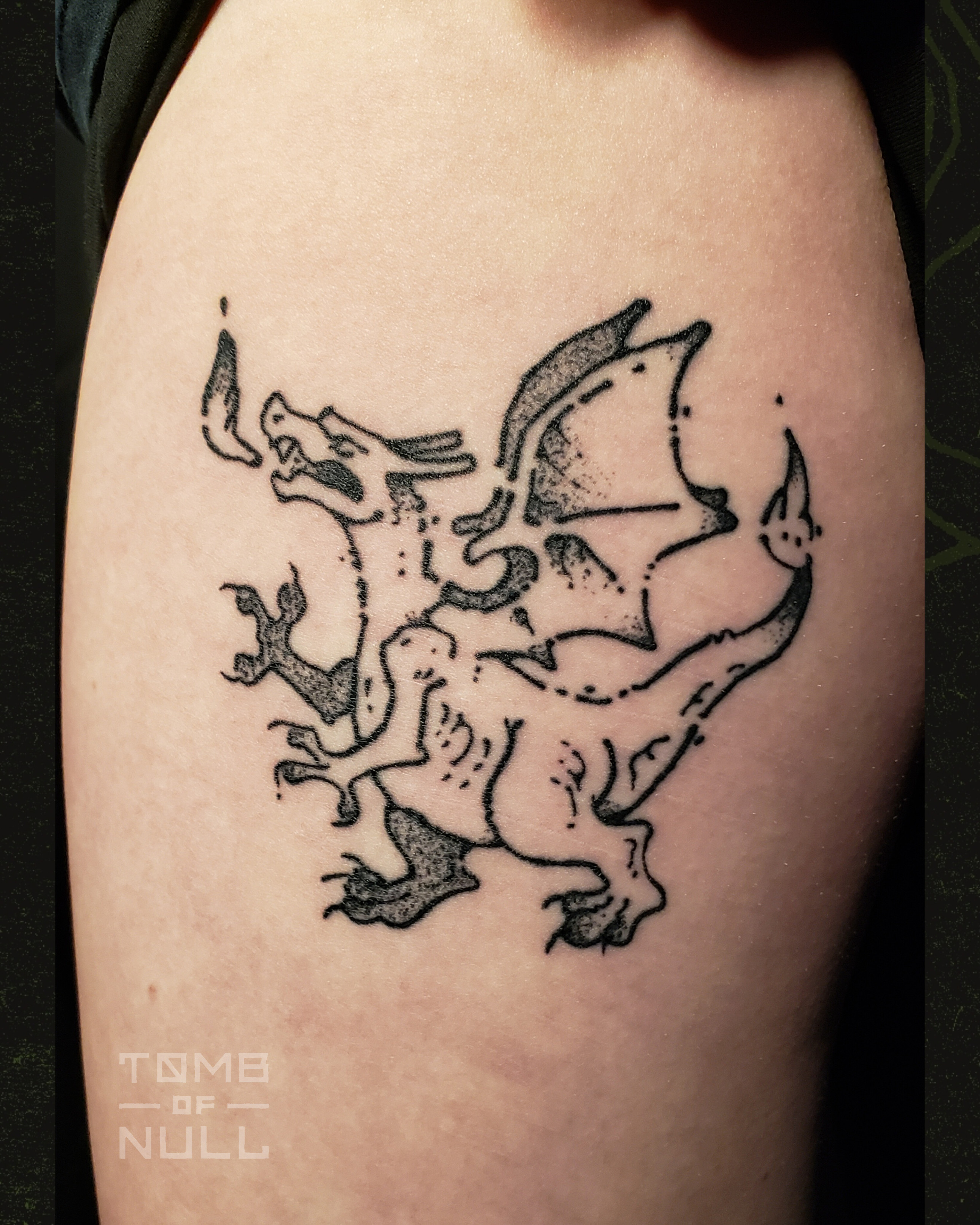
CONCEPT: at my job, we usually do tattoo flash sales as a fundraiser for various local organizations. In most cases, participating artists are given free reign on what we want to make for these events. For this go, I opted for pokemon but done up in a way inspired by medieval bestiaries. To me, drawing parallels between these old catalogs of creatures and the way pokemon fans build their own catalogs of cards, art, and media of their favorite pokes–creatures that can look just as absurd as some of the subjects in those old bestiaries–is a fun change-up on the usual way folks will celebrate their favorite pokes in a tattoo. [It also appeared I wasn’t the only one with this idea. I ended slipping this weird dude in to the mix. Partly because, will, look at it, and because they’d make for a good style study before jumping into the other pieces].
There’s also another factor I have to consider: this being the work I rely on to put bread on the table, weather or not this concept is something that other would be willing to pay for [and in the case of tattoo, endure the pain and have on their bodies for a lifetime] is a factor. Looking to past experiences, both medieval creatures and pokemon are things that have done well for me in this regard. Would having these two ideas overlap be just as successful? My hunch was that it’d be likely, but there’s also a chance that this would be one of those things that I think is neat, but I can’t convince others to see that, too.
MATERIALS: I need to work within the budget provided: pieces could be either $85, $120, or $150. Bare in mind that, as a tattoo artist, I only pocket a portion of what is being charged to the client. This means I need to be extra mindful about the materials I’ll need to execute these pieces, and how quickly they can be done for folks [both to make sure I stay in the black and being mindful of my client’s pain and comfort].
I opted to stick with using only black ink for these pieces, and only used lining and stippling techniques. This also means that, for most pieces, I only have to use one or two needle cartages per piece, only need to account for wrapping my liner machine, so on.
These pieces also need to be on the smaller size [2-3.5-ish inches] to keep execution time short. Tattoo is a high-contrast medium, and you can only pack so many details into the skin before a piece will age into something illegible years down the line. I need to be extra mindful of my line economy, while also still designing pieces that look and feel like completed artworks.
On hand, I had a growing collection of scans and photos of medieval bestiary illustrations I can study to get the feel for these pieces right, and model sheets of the pokemon I’d like to do for this project.
EXECUTION: I drew up some rough physical sketches to get an idea of size, scanned and refined those sketches, then lined and stippled everything. I also dressed up the flash sheet to fit the theme.
And turns out, there were other people who found these guys charming enough to let me put these on them! I was able to knock out each of these pieces pretty quickly.
EXAMPLE 3 | FREE-FORM
I have a big, cheap sketchbook I like to play in. My goal when drawing anything in this sketchbook is to just play. No pressure, no worrying about if something will come out good or not, not thinking about if this could be monetized in some way, no grand manifestos or highfalutin motivations. Just play.
Sometimes this means I’m putting lines to paper for solely sensory enjoyment, head empty and hands busy wondering the page, leaving trails of ink in their wake. Sometimes a hazy idea brewing in the back of my brain bubbles out from the scrawls and I explore that further, fleshed out more and more as the image in my head gets clearer.
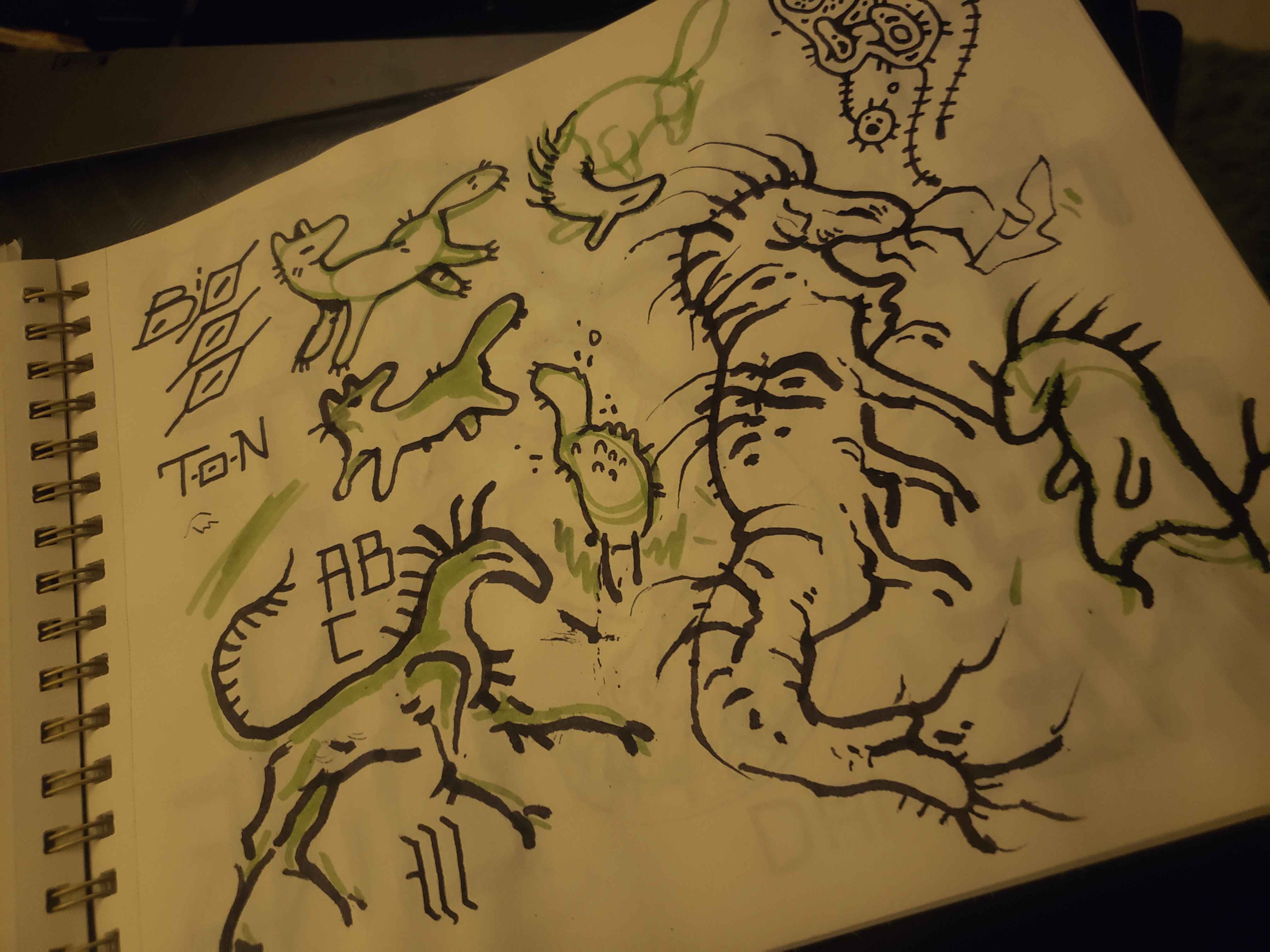
In this approach, I am weaving in and out of each of these elements without care. If something catches my eye, I’ll use these elements as a vague compass if I need some guidance, but otherwise I’m exploring for the sake of exploring. In the end, I’ll sometimes yield complete pieces or drafts to revisit later.
Struggling to come up with a conclusion. Anyway, I’m sure I’m not the first person to come up with this process, nor am I the only person to have their own way of going about creating things. Do you do something similar? Something different? Comments should be open, and you can always poke me on my socials.
Listening to: Raze by Chiminyo
Reading: Cult of the Lamb guide
Phase: Waning Gibbous
Weather: Crisp and cool, but not too cool. I should go on a picnic soon.